Three technologies keep getting proposed as the answer to biased AI. Here is what each one genuinely contributes — and the parts that are usually oversold.
By Mohammad Alabra
Most teams that ship AI can tell you, to two decimal places, how accurate their model is. Far fewer can answer a different and increasingly important question: a year from now, can anyone prove that the fairness assessment you ran before launch actually said what you claim it said — and that nobody quietly edited it after it was approved?
That gap — between measuring bias and being able to govern it in a way outsiders can trust — is where a great deal of responsible-AI work still falls short. We have made real progress detecting and explaining bias. We have made much less on keeping the evaluation itself transparent, auditable, and tamper-resistant.
Three technologies are increasingly proposed to close that gap: Explainable AI, autonomous AI agents, and blockchain. Used carelessly, that combination is a buzzword pile-up. Used precisely — with a clear-eyed view of what each part does and does not do — it points to a genuinely useful governance architecture. This article makes the case for the precise version, and stays honest about the limits, because a governance framework that oversells itself destroys the very trust it is meant to create.
The problem isn’t detecting bias. It’s governing it.
Bias appears when a model systematically produces worse outcomes for particular people or groups — because of the training data, the features, the model design, or the context it is deployed into. Nobody seriously believes a single technique removes it. Bias has to be managed continuously: monitored, assessed, reviewed by humans, and documented across the model’s life.
Most production pipelines already handle data collection, preprocessing, training, evaluation, deployment, and monitoring, and they track accuracy obsessively. The questions they struggle with are governance questions:
• Was the model checked against agreed fairness metrics before it was approved?
• Were those results changed after sign-off?
• Can an earlier version — and the evaluation that cleared it — be reconstructed and independently checked?
• Can a regulator verify how a fairness decision was actually made?
None of these are machine-learning problems. They are questions of record-keeping and trust — between a vendor, the organization deploying the model, the people affected by it, and the regulator, none of whom fully trust each other.
Explainable AI: necessary, but not enough
Explainable AI (XAI) helps people understand why a model produced a given output. Tools like SHAP, LIME, and counterfactual explanations let analysts inspect behavior and spot likely sources of bias. That understanding is essential.
But understanding is not accountability. XAI on its own does not produce a permanent audit record, does not monitor fairness continuously, and does not let a third party verify that an evaluation ever happened as claimed. It tells you what the model did. It does not preserve a trustworthy account of what your governance process did. Closing that gap is the job of the next two pieces.
AI agents: continuous auditors, with two honest caveats
Autonomous agents let you move from occasional manual fairness reviews to continuous evaluation. A governance agent can compute fairness metrics on live traffic, watch for drift, compare performance across groups, check behavior against policy, raise alerts when a threshold is crossed, and assemble structured audit reports on a schedule. That is a real upgrade over a spreadsheet someone fills in once a quarter.
Two caveats matter, and a serious design has to face them rather than wave them away.
Fairness is not one objective number. The common criteria — demographic parity, equalized odds, calibration — are mathematically incompatible except in trivial cases; you generally cannot satisfy all of them at once. Deciding which one should govern a given system is a judgment about values and context, not a calculation. An agent can measure whatever metric it is told to. It cannot legitimately decide which definition of fairness is the right one — that belongs to humans, and the choice should be recorded as an explicit policy.
Who audits the auditor? If the agent’s own logic is flawed, it can certify unfairness as fair. So the agent is a governance assistant that keeps humans continuously informed — not a replacement for human judgment — and its own code and configuration have to be versioned and attested, exactly like the model it watches.
Blockchain: a tamper-evident record — and nothing more
This is where these proposals usually overreach, so it is worth being blunt.
Blockchain does not reduce bias, improve accuracy, or replace fairness algorithms. It does one narrow thing: it provides a tamper-evident, append-only record of what your governance process did.
After the agent finishes an evaluation, you record a cryptographic hash of the report — not the report itself — along with a little non-sensitive metadata: model version, dataset version, a reference to the explainability report, the agent’s identity and version, a timestamp, and a signature. Anyone holding the original report can later recompute the hash and confirm it matches, proving the report was not altered after sign-off.
Two things keep this honest.
Integrity is not truthfulness. A hash proves only that a specific report existed at a certain time and hasn’t changed since. It says nothing about whether the evaluation was correct, whether the right metric was chosen, or whether the agent was honest. Anchor a flawed report immutably and all you get is a permanent, verifiable copy of a flawed report. The quality of what goes in still depends entirely on the layers above and on human review.
And does it even have to be a blockchain? The honest hard question is: why not just keep a signed, timestamped, append-only log inside one organization? For many teams, that is enough — a hash-chained log with trusted timestamping, or a public transparency log like the ones used for web certificates, gives you tamper-evidence without a blockchain’s cost and complexity. A distributed ledger earns its keep in one specific situation: when no single party is trusted to hold the record — when a vendor, its customers, and a regulator all need a shared log that none of them can quietly rewrite. In that low-trust, multi-party setting, a permissioned blockchain is a reasonable choice. Where one trusted custodian exists, a simpler signed log is usually the better engineering answer. Reaching for a blockchain by default is how these projects lose credibility.
One more constraint is easy to miss: fairness-by-group needs protected attributes — exactly the data that privacy laws like the GDPR and the UAE’s PDPL restrict, including a right to erasure that collides head-on with an immutable ledger. So only hashes and non-sensitive metadata go on-chain. The reports and any personal data stay off-chain, in ordinary, access-controlled, deletable storage.
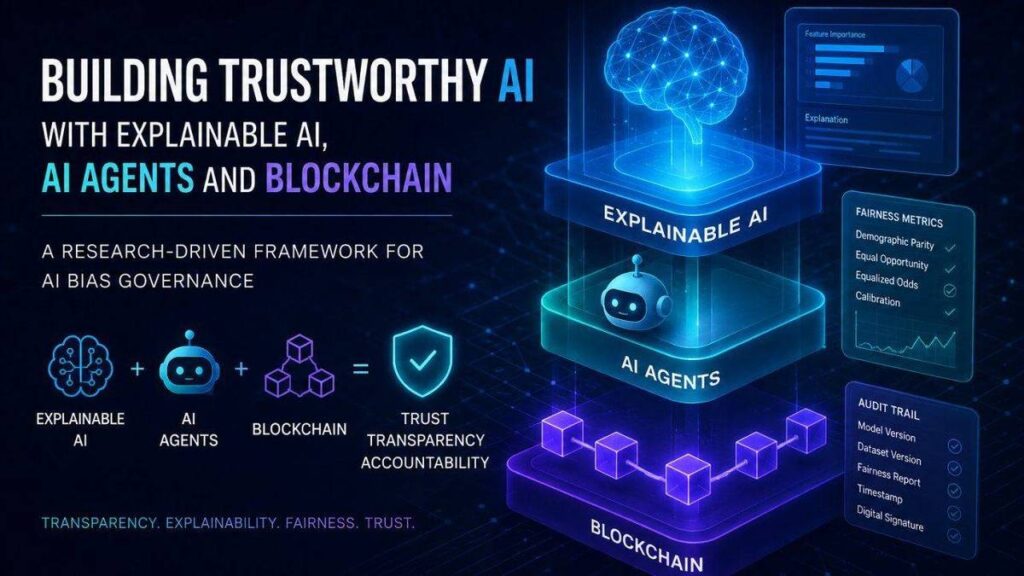
The architecture, in one picture
Put together, it is four cooperating layers, each with one job:
1. The model makes predictions and decisions.
2. Explainable AI explains those decisions and surfaces influential features.
3. The governance agent continuously measures the human-chosen fairness metrics, watches for drift, and produces audit reports.
4. The ledger stores cryptographic proofs of those governance activities so the record is tamper-evident and independently verifiable.
The separation is the whole point. The model decides, XAI explains, the agent measures against a human-set policy, and the ledger preserves an honest trail — with no layer pretending to do another’s job.
What it looks like in practice
Take an AI platform that flags network events as benign or malicious. A governance agent periodically checks whether the model behaves unfairly toward particular customer environments, regions, or configurations — against a fairness policy the organization’s people have chosen and written down. It computes the agreed metrics and produces a report.
Instead of putting the report on-chain, the system commits its hash together with the model version, the agent’s version, and a timestamp. Months later, an auditor looking into a dispute can pull the original report, recompute the hash, and confirm it is the one approved at launch — or discover that it isn’t. The ledger strengthens trust in the process. The substance still rests on the model, the metric choice, and human oversight.
The honest conclusion
Responsible AI needs more than an accurate model. It needs systems whose fairness can be understood, whose governance can be audited, and whose audit trail cannot be quietly rewritten. Explainable AI supports the understanding. Autonomous agents support the continuous oversight. A cryptographic ledger supports the tamper-evident trust — but only over records whose content still has to be earned by everything beneath it.
Treated that way — as complementary controls with clearly bounded guarantees, not a single technology sold as a cure — this combination is a genuinely promising direction for AI governance, regulatory compliance, and trustworthy AI. It is still a proposal, not a finished standard. And being honest about where it stops is a large part of what makes it worth building.
Further reading
The NIST AI Risk Management Framework and NIST SP 1270 on managing bias; the OECD AI Principles, ISO/IEC 42001, and the EU AI Act on governance and compliance; Kleinberg, Mullainathan and Raghavan, and Chouldechova, on why fairness metrics conflict; and Model Cards (Mitchell et al.) and Datasheets for Datasets (Gebru et al.) on documenting models and data — the practice this architecture makes tamper-evident.
This article was first published on LinkedIn.