By Mohammad Alabra
For many years, Blockchain and Artificial Intelligence evolved along separate paths.
Blockchain emerged as a trusted infrastructure for recording, verifying, and exchanging digital value without relying on centralized intermediaries. Meanwhile, Artificial Intelligence transformed organizations' ability to analyze data, automate processes, and make decisions with unprecedented speed and efficiency.
Today, these two technological trajectories are increasingly converging.
Researchers, policymakers, and industry leaders are rapidly exploring how integrating Blockchain and AI can create digital ecosystems that are more transparent, secure, and decentralized. Although significant technical challenges remain, there is growing consensus that this convergence could reshape industries ranging from healthcare and financial services to supply chains and smart cities.
Why Does Artificial Intelligence Need Blockchain?
Artificial Intelligence fundamentally depends on data.
The higher the quality of the data used to train models, the more accurate and reliable the resulting outputs become. However, the rapid expansion of AI applications has raised critical concerns regarding data authenticity, ownership, transparency, and governance.
This is where Blockchain plays a pivotal role.
Thanks to its decentralized and immutable nature, Blockchain can provide a trusted record of data origin, ownership, and modification history, adding an essential layer of trust to AI ecosystems.
Simply put:
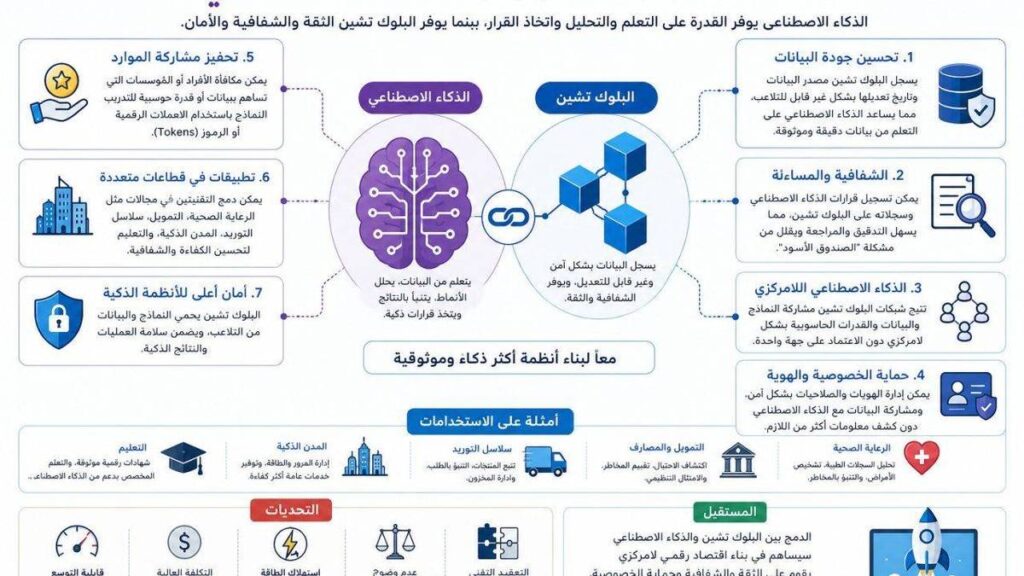
- Artificial Intelligence provides learning and analytical capabilities.
- Blockchain provides trust and transparency.
Together, they enable the development of more reliable and accountable digital systems.
Data Provenance: The Missing Layer in AI
Data integrity represents one of the greatest challenges facing modern AI applications.
Organizations increasingly face critical questions such as:
- Where did the training data originate?
- Has the data been altered or manipulated?
- Was the data collected ethically and legally?
- Can the integrity of the data be verified over time?
Blockchain can record the entire lifecycle of data, from creation to model training, creating a permanent and immutable audit trail.
This capability is particularly important in highly regulated sectors.
For example, in healthcare, Blockchain can protect medical records and ensure the integrity of data used to train diagnostic AI systems. Similarly, financial institutions can leverage Blockchain to validate the integrity of datasets used in risk assessment and regulatory compliance models.
Addressing the AI "Black Box" Problem
Many advanced AI systems suffer from what is commonly referred to as the "black box" problem, where models generate decisions or predictions without clearly explaining how those outcomes were reached.
Transparency and explainability have therefore become major concerns for regulators, organizations, and end users alike.
Blockchain can enhance accountability by maintaining immutable records that include:
- Model versions.
- Training datasets.
- Training and update logs.
- Inference and prediction outcomes.
- Governance and audit activities.
Although Blockchain does not inherently make AI models explainable, it provides a trusted environment for auditing and verification, significantly enhancing confidence in intelligent systems.
The Rise of Decentralized Artificial Intelligence
Today, a relatively small number of global technology companies dominate AI infrastructure due to their ownership of massive datasets and computational resources.
The concept of decentralized AI seeks to redistribute this concentration of power.
By leveraging Blockchain-based networks, participants can contribute:
- Data.
- Computing power.
- AI model development.
- Storage services.
In return, contributors may be rewarded through token-based economic models.
This approach has the potential to reduce monopolization, broaden access to AI technologies, and accelerate innovation.
However, the long-term economic viability of such decentralized models remains under evaluation and has not yet been conclusively established.
Enhancing Privacy and Digital Identity
As AI systems increasingly rely on personal data, the need for stronger privacy mechanisms continues to grow.
Blockchain can enable new digital identity frameworks that allow individuals to retain greater control over their personal information, precisely determining what data can be accessed and how it may be used.
These capabilities are expected to play an important role in sectors such as healthcare, government services, and financial services.
Real-World Applications Across Industries
Healthcare
Artificial Intelligence can support early disease detection and medical image analysis, while Blockchain ensures the integrity and privacy of patient records.
Financial Services
Financial institutions use AI for fraud detection, risk assessment, and compliance management, while Blockchain provides transparent and tamper-resistant transaction records.
Supply Chain Management
Blockchain can track products throughout the supply chain, while AI helps forecast demand and optimize inventory and logistics operations.
Smart Cities
AI supports traffic management, energy optimization, and public service delivery, while Blockchain secures data exchanges between connected systems and devices.
Challenges That Still Remain
Despite the significant potential of integrating these technologies, several challenges persist.
Scalability
Many Blockchain networks still face limitations in transaction throughput compared with the demands of large-scale AI applications.
Computational Costs
Training AI models requires substantial computational resources, and integrating Blockchain may increase operational expenses.
Energy Consumption
Certain Blockchain consensus mechanisms continue to consume significant amounts of energy, although more efficient alternatives have emerged in recent years.
Regulatory Uncertainty
Global regulatory frameworks governing AI and decentralized technologies are still evolving.
Technical Complexity
Developing integrated AI and Blockchain solutions requires multidisciplinary expertise spanning machine learning, cybersecurity, distributed systems, and data governance.
Looking Ahead
The convergence of Blockchain and Artificial Intelligence is unlikely to replace traditional digital infrastructures in the near term.
However, current trends indicate that this integration may become a foundational layer for building AI systems that are more trustworthy, transparent, and accountable.
Organizations that begin exploring this technological intersection today may be better positioned to benefit from the next wave of digital transformation.
The future of Artificial Intelligence depends not only on making machines smarter, but also on making them more trustworthy.
This article was first published on LinkedIn.