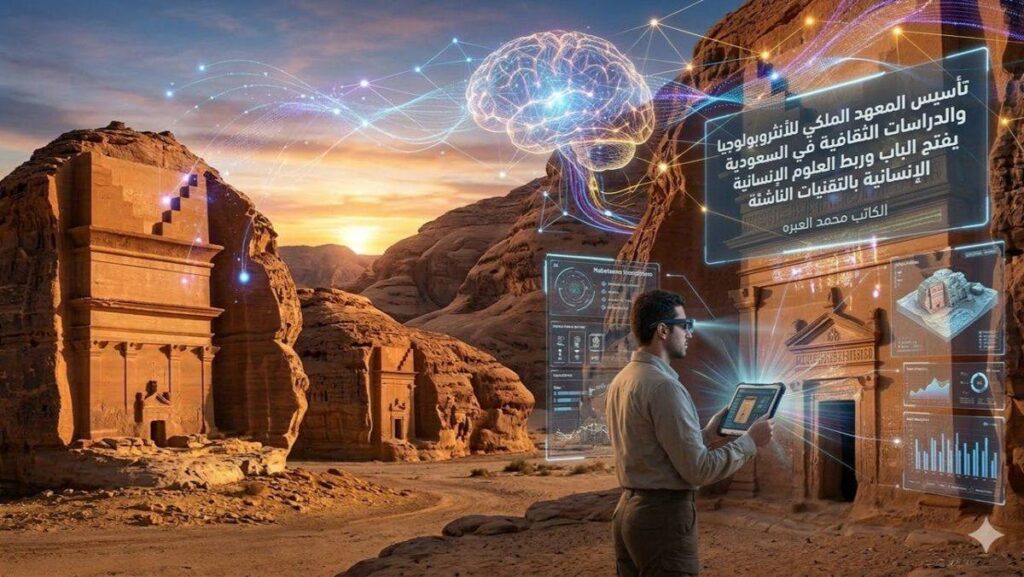
The decision by the Council of Ministers of the Kingdom of Saudi Arabia to approve the establishment of the Royal Institute of Anthropology and Cultural Studies represents an important step toward strengthening scientific research aimed at understanding society, culture, and social transformation in the Kingdom, at a time when the world is witnessing a notable shift in the relationship between the humanities and advanced digital technologies.
Contemporary anthropology is no longer limited to traditional fieldwork or descriptive studies of cultures; it increasingly intersects with artificial intelligence and emerging technologies such as virtual reality (VR), augmented reality (AR), and cultural data analysis, tools that academic and cultural institutions around the world are using to reshape the ways in which humans and society are studied.
Several experiences from around the world show how these technologies can contribute to advancing cultural and anthropological studies.
In India, the government launched the Indian Digital Heritage (IDH) project, which employs artificial intelligence, 3D modeling, and virtual reality to reconstruct cultural heritage sites such as the temples of Hampi and Konark. These technologies have been used at the National Museum in New Delhi to offer interactive digital experiences that allow visitors and researchers to explore Indian heritage in an immersive virtual environment.
In the United Kingdom, the British Museum used augmented reality in interactive educational programs about the Parthenon sculptures, with tablets allowing visitors to interact with the artifacts through digital visual and narrative content that reinterprets the historical and cultural contexts of those pieces.
In Europe, the Through the Wardrobe project in Amsterdam offered an anthropological experience based on augmented reality, in which visitors use digital glasses to explore the stories and life experiences of people from diverse communities, allowing ethnographic knowledge to be conveyed as a sensory, interactive experience rather than relying solely on traditional textual description.
In the United States, the Water Heritage Anthropological Project at Utah State University has worked on developing what is known as "Virtual Archaeology," in which virtual environments and 3D data are used to enable students and researchers – especially those from Indigenous communities – to study archaeological sites and carry out research work remotely.
International organizations such as UNESCO are also working on digital initiatives to preserve endangered Indigenous languages using artificial intelligence tools and digital technologies, including projects such as the Missing Scripts Initiative, which aims to protect writing systems and languages that are not represented in the digital space.
In China, applied studies at the Liangzhu Museum have shown that using augmented reality glasses in museums can enhance the visitor experience and increase engagement with cultural heritage by combining historical authenticity with an interactive digital experience.
In the Arab context, field experiments are also an important part of developing this field. In the city of Petra in Jordan, an experiment was carried out using augmented reality (AR) technologies to provide a digital interpretation of the Djinn Blocks, one of the prominent Nabataean landmarks at the archaeological site. The experiment aimed to use augmented reality to explain the historical and symbolic background of these Nabataean monuments and to offer visitors an interactive learning experience that brings together the archaeological site and digital content.
This experiment can be viewed at the following link:
https://youtu.be/hyz7anv6zhY?si=lkye5UFhOLFr0Yaw
These experiences indicate that what is known today as Digital Anthropology has become one of the fastest-growing fields worldwide, with artificial intelligence tools and big data analytics being used to study languages, cultures, and social patterns, as well as to study digital communities themselves and the impact of technology on identity and culture.
In this context, the Royal Institute of Anthropology and Cultural Studies could become an important scientific platform for linking humanities research in the Kingdom with global developments in the use of emerging technologies to study culture and society.
In a world that is changing rapidly as a result of digital transformation, understanding humans and culture is no longer possible through traditional methods alone; it requires integrating humanistic knowledge with modern technological tools to gain a deeper understanding of the social and cultural transformations of the twenty-first century.
Translated from the original Arabic article, first published on LinkedIn. اقرأ النسخة العربية