The global quantum computing race is moving into a more mature phase, where major technology announcements intersect with strategic and security decisions that reflect the field’s shift from theoretical research to realistic planning for deployment. The latest developments announced by companies such as Google and IBM in March 2026 confirm this shift, but they also reveal a persistent gap between scientific progress and broad commercial adoption.
Technical Expansion at Google and a Shift in Strategy
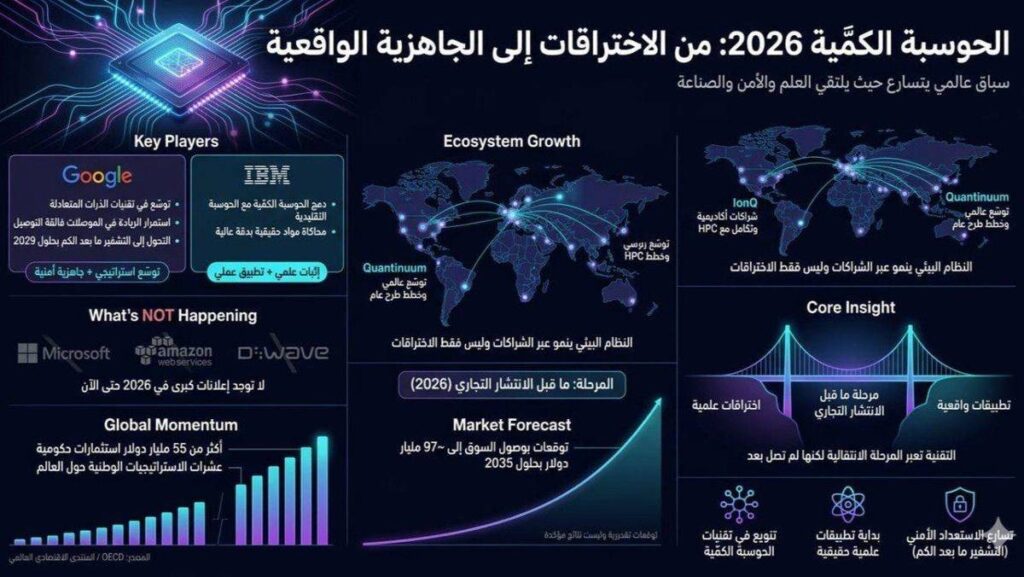
This week, Google announced a notable strategic move by officially entering the field of neutral-atom quantum computing (neutral atoms), alongside its core platform based on superconductors.
This decision reflects a growing recognition within the industry that no single hardware technology has become dominant yet.
- Superconductors offer better operating speed and circuit depth
- Neutral atoms offer greater scalability and a larger number of qubits
In parallel, the company set an internal timeline for transitioning to Post-Quantum Cryptography by 2029, a clear sign that the security risks associated with quantum computing have become a matter of real planning rather than theory.
Assessment:
- Impact: long-term strategic
- Confidence level: high
- Significance: hardware diversification + accelerated security readiness
IBM Pushes Toward Real Scientific Use
IBM, by contrast, focused on strengthening the practical value of quantum computing rather than simply expanding its platforms.
Its two most notable announcements in March 2026:
- Introducing a quantum-centric supercomputing architecture that integrates QPUs with traditional HPC systems
- A quantum computer successfully simulating a real magnetic material, with results matching data from national laboratories
These results represent an important step toward proving that quantum computing can become a reliable scientific tool, especially in fields such as materials science and quantum chemistry.
Assessment:
- Impact: direct scientific/applied
- Confidence level: high
- Significance: the beginning of limited real-world use cases
Commercial Expansion and Innovation Networks Among Startups
Other companies such as IonQ and Quantinuum announced significant moves in 2026, but these were mainly focused on enterprise and commercial expansion:
- IonQ: academic partnerships (University of Cambridge), HPC integration projects using NVIDIA
- Quantinuum: expansion into Asia, preparations for an initial public offering (IPO)
These announcements reflect the maturity of the ecosystem more than direct technical breakthroughs.
Assessment:
- Impact: economic/ecosystem
- Confidence level: high
- Significance: building a market rather than a scientific breakthrough
A Relative Absence of Major Announcements from Some Players
As of March 26, 2026, no comparable major announcements had emerged from:
- Microsoft (its last major announcement was in 2025)
- Amazon Web Services (focused on operational improvements)
- D-Wave (no major new technical announcement in 2026 so far)
Assessment:
- Confidence level: medium to high
- Note: there may be minor updates that do not affect the overall picture
The Global Context: Policies and Investments Are Accelerating
Alongside these announcements, recent international reports from the OECD and the World Economic Forum point to:
- Global government commitments exceeding $55 billion since 2013
- Dozens of national strategies across Europe, the Americas, and Asia
- A shift in focus from research to economic and institutional readiness
At the same time, McKinsey & Company estimates that the quantum technology market could reach tens of billions of dollars by 2035, with quantum computing likely to dominate.
Confidence level:
- Policies and investments: high
- Market forecasts: medium
The Apparent Contradiction: Rapid Progress Without Widespread Adoption
When all the sources are compared, a clear pattern emerges:
There is no real contradiction, only a difference in the angle of measurement:
- Scientific reports → tangible technical progress
- Economic reports → long-term forecasts
- Regulatory reports → early preparation
But the common conclusion is:
Quantum computing is advancing rapidly, but it has not yet reached the stage of large-scale commercial use.
What Actually Changed in 2026?
The shift can be summarized in three key points:
1) Diversifying Technical Paths
Companies are no longer betting on a single technology (as Google previously did).
2) The Beginning of Proven Scientific Use
IBM has presented some of the strongest evidence yet of practical value.
3) Accelerating Security Readiness
The transition to post-quantum cryptography has begun to enter real timelines.
Data from 2026 indicates that quantum computing has entered a new phase that can be described as:
“The Pre-Commercial Phase”
In which:
- The science works (growing body of proof)
- The market is getting ready (investments and partnerships)
- Security is moving early (PQC)
However:
- Broad commercial use is still limited
- And economic forecasts remain scenarios rather than confirmed outcomes
Translated from the original Arabic article, first published on LinkedIn. اقرأ النسخة العربية